SAND EQUIVALENT TEST APPARATUS in Chandigarh
Get In Touch
Sand Equivalent Test Apparatus in Chandigarh – Technical Testing Equipment
The Sand Equivalent Test Apparatus in Chandigarh is used to determine the relative proportion of clay-like or plastic fines and dust present in granular soils and fine aggregates. The test is particularly relevant to aggregate quality control, road construction, pavement materials, and civil engineering laboratory testing.
ASTM D2419 describes the sand equivalent test as a method for indicating the relative proportions of clay-like or plastic fines and dust in granular soils and fine aggregates passing the 4.75 mm (No. 4) sieve. The method is also used as a rapid field-correlation test for monitoring changes in aggregate quality.
Civil Testing Equipment can provide information on the Sand Equivalent Test Apparatus in Chandigarh according to the buyer's required application, testing method, and configuration. For accurate procurement, the required standard should be specified before the final quotation.
Sand Equivalent Test Apparatus Manufacturer in Chandigarh
For buyers searching for a Sand Equivalent Test Apparatus Manufacturer in Chandigarh, the most important consideration is whether the offered apparatus matches the required test method and configuration.
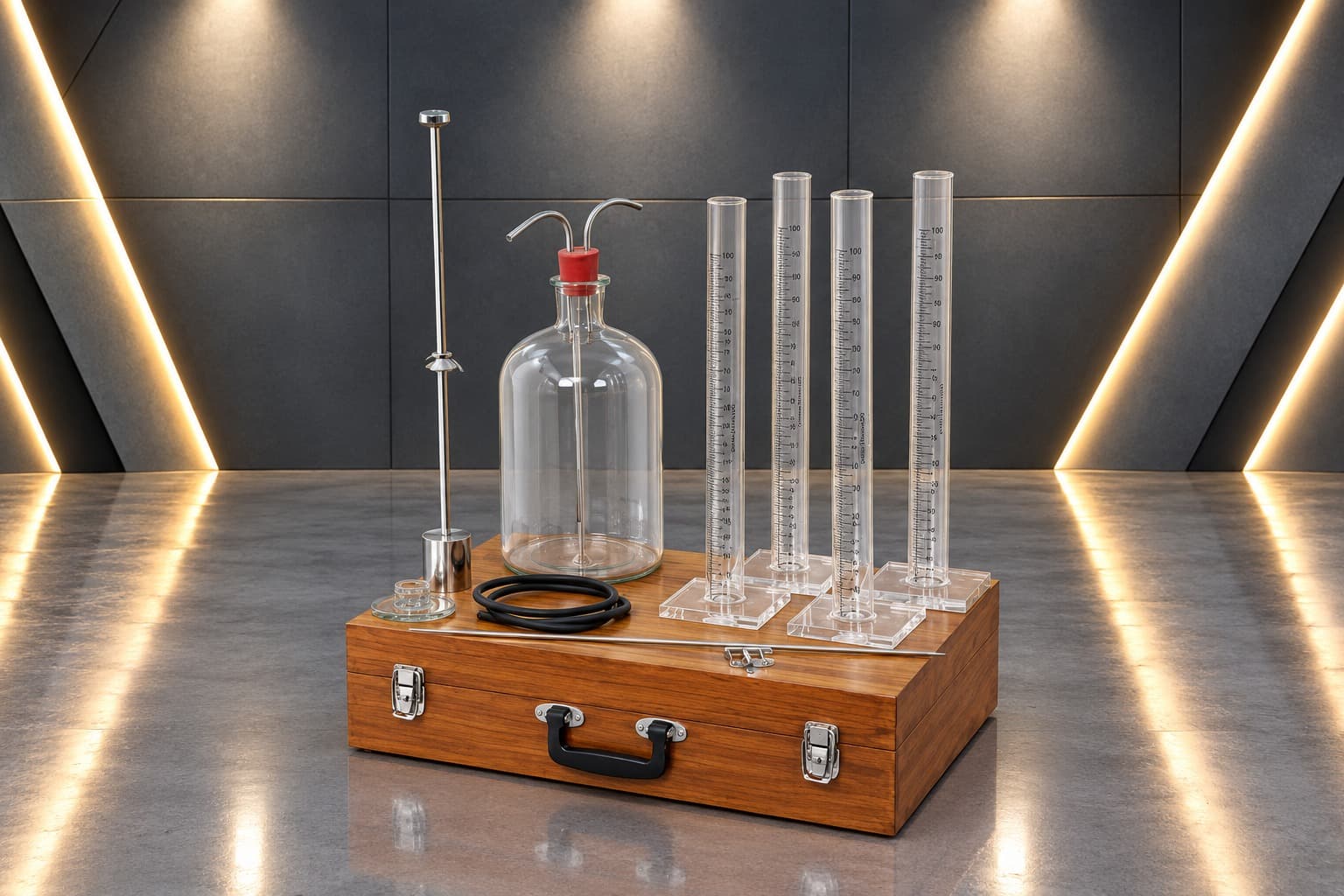
The apparatus used for sand equivalent testing can include graduated measuring cylinders, an irrigator or siphon assembly, weighted foot or plunger assembly, measuring container, funnel, ruler, and a suitable agitation arrangement. The exact combination should be confirmed against the applicable test method and the actual product configuration being supplied.
Civil Testing Equipment can discuss the required Sand Equivalent Test Apparatus Manufacturer in Chandigarh configuration with buyers before quotation rather than assuming that one configuration is suitable for every laboratory.
The Sand Equivalent Test Apparatus in Chandigarh should be selected according to the laboratory's testing procedure, sample requirements, applicable standard, and required accessories.
Sand Equivalent Test Apparatus Supplier in Chandigarh
A Sand Equivalent Test Apparatus Supplier in Chandigarh should provide clear technical information before order confirmation. Buyers should be able to verify the measuring-cylinder arrangement, weighted foot, irrigator system, siphon assembly, measuring accessories, and shaker requirement where applicable.
For laboratories following ASTM D2419 or AASHTO T 176, the buyer should specify the exact edition and required configuration. ASTM currently lists D2419-22 as the active standard, while AASHTO's current materials list T 176-22 as the revised sand-equivalent test method.
The Sand Equivalent Test Apparatus Supplier in Chandigarh should therefore quote against the actual requirement instead of using a generic “standard model” description.
Sand Equivalent Test Apparatus Exporter in Chandigarh
If export supply is required, the Sand Equivalent Test Apparatus Exporter in Chandigarh should confirm the destination, quantity, packing requirements, documentation, testing standard, and exact equipment configuration before shipment.
Export capability should be confirmed as part of the commercial quotation rather than assumed from the product description.
For an international enquiry, buyers should provide:
- Destination country
- Required quantity
- Applicable test standard
- Required accessories
- Electrical requirement, if a shaker is included
- Packaging requirements
- Documentation requirements
The Sand Equivalent Test Apparatus Exporter in Chandigarh can then confirm whether the requested configuration can be supplied for the specific project.
Sand Equivalent Test Apparatus Distributor in Chandigarh
A Sand Equivalent Test Apparatus Distributor in Chandigarh should help the buyer identify the correct configuration for the intended testing procedure.
This is particularly important because a basic manual sand-equivalent setup and a complete laboratory setup with mechanical agitation are not necessarily the same configuration.
For procurement, buyers should confirm:
- Number of graduated cylinders
- Type of weighted foot/plunger
- Irrigator and siphon arrangement
- Measuring container
- Funnel and ruler
- Shaker requirement
- Applicable test standard
- Any project-specific documentation
Civil Testing Equipment can discuss these requirements before finalizing the Sand Equivalent Test Apparatus Distributor in Chandigarh quotation.
Technical Specifications
The following table distinguishes standard-related requirements from specifications that must be confirmed for the actual supplied model.
| Parameter | Requirement / Verification |
|---|---|
| Test | Sand Equivalent Value |
| Primary application | Granular soils and fine aggregates |
| ASTM reference | ASTM D2419-22, where applicable |
| AASHTO reference | AASHTO T 176-22, where applicable |
| Material size referenced by ASTM | Material passing 4.75 mm (No. 4) sieve |
| Measuring cylinder | Transparent graduated cylinder; dimensions to be confirmed against selected standard/model |
| Weighted foot / plunger | Required for the applicable test configuration |
| Irrigator assembly | Required according to selected test method |
| Siphon assembly | Required where specified by the selected configuration |
| Measuring container | Confirm size against applicable standard |
| Funnel | Confirm with selected apparatus set |
| Ruler / reading device | Confirm with supplied configuration |
| Shaker | Manual or mechanical according to applicable procedure |
| Mechanical shaker dimensions | Must be verified against the current applicable standard before being stated as product specifications |
| Electrical supply | Applicable only if a motorized shaker is supplied; confirm model |
| Product dimensions | Confirm against actual supplied model |
| Product weight | Confirm against actual supplied model |
Important Technical Note
Do not publish a fixed shaker throw, cycles/minute, cylinder dimensions, weighted-foot mass, or overall apparatus dimensions on the product page unless those values have been verified against the actual model and the specific standard edition being claimed.
ASTM D2419-22 identifies equipment capability, maintenance, and calibration as factors affecting the quality of test results.
This approach prevents a common product-page error: presenting a third-party standard's apparatus dimensions as if they were the manufacturer's own guaranteed product specifications.
ASTM D2419 and AASHTO T 176
The Sand Equivalent Test Apparatus in Chandigarh can be selected for testing procedures based on recognized methods such as ASTM D2419 and AASHTO T 176, subject to the actual product configuration.
ASTM D2419-22 covers the determination of sand equivalent value of soils and fine aggregate and describes the test's purpose as indicating the relative proportions of clay-size or plastic fines and dust.
AASHTO's current standards listing identifies T 176-22 – Plastic Fines in Graded Aggregates and Soils by Use of the Sand Equivalent Test and notes revisions to the method, including changes related to sample size and temperature-measuring devices.
Therefore, the product should not be described as “ASTM D2419 compliant” or “AASHTO T 176 compliant” unless the supplied configuration has been checked against the relevant standard.
Main Apparatus Components
A complete sand equivalent testing setup may include the following components, depending on the selected configuration:
- Transparent graduated measuring cylinder
- Rubber stopper
- Irrigator tube
- Siphon assembly
- Working-solution container
- Weighted foot or plunger assembly
- Measuring container
- Wide-mouth funnel
- Ruler or measurement scale
- Manual shaker, where applicable
- Mechanical shaker, where applicable
- Carrying/storage case, if included in the selected supply
Actual supplied accessories should be confirmed from the quotation or product datasheet.
This is important because different commercial sand-equivalent test sets are available with different numbers of cylinders and accessory combinations.
How the Sand Equivalent Test Works
The test evaluates the relative amount of sand-sized material and clay-like fines in a prepared sample.
Sample Preparation
The test specimen is prepared according to the selected testing procedure. ASTM D2419 specifically addresses granular soils and fine aggregates passing the 4.75 mm (No. 4) sieve.
Filling and Agitation
The prepared material is introduced into the measuring cylinder with the specified working solution. The sample is then agitated according to the applicable procedure.
Irrigation and Settlement
The irrigation process helps suspend the finer particles while the heavier sand fraction settles. After the specified settlement period, the relevant sand and clay readings are obtained.
Calculation
The sand equivalent value is determined from the applicable sand and clay readings according to the test method being followed.
The exact sample preparation, agitation, settlement, measurement, and calculation procedure should always be taken from the current applicable standard rather than from a generic product description.
Key Features
The Sand Equivalent Test Apparatus in Chandigarh is suitable for laboratories and quality-control applications where the relative presence of clay-like fines needs to be evaluated.
Key features include:
- Suitable for sand equivalent testing
- Designed for granular soil and fine aggregate evaluation
- Transparent graduated cylinder arrangement
- Weighted foot or plunger assembly
- Irrigator and siphon arrangement
- Suitable for manual test procedures
- Mechanical shaker configuration available where applicable
- Useful for road and pavement material testing
- Suitable for laboratory quality control
- Configuration can be matched to the specified testing method
Applications
The Sand Equivalent Test Apparatus Manufacturer in Chandigarh can support applications involving:
- Road aggregate testing
- Highway construction materials
- Pavement material quality control
- Fine aggregate evaluation
- Granular soil testing
- Aggregate production quality control
- Civil engineering laboratories
- Infrastructure projects
- Construction material testing
- Research and educational laboratories
The test is especially useful where the relative presence of clay-like or plastic fines is an important consideration in aggregate quality.
Industries and End Users
The Sand Equivalent Test Apparatus Supplier in Chandigarh can be relevant to:
- Highway contractors
- Road construction companies
- Aggregate producers
- Infrastructure companies
- Civil engineering laboratories
- Material-testing laboratories
- Engineering consultants
- Universities and technical institutes
- Research laboratories
- Construction quality-control departments
Quality and Trust Verification
For a laboratory instrument, trust should come from verifiable product information, not unsupported marketing claims.
Before placing an order, the buyer should confirm:
- Actual product photographs
- Complete list of supplied accessories
- Product model or identification
- Applicable test standard
- Technical datasheet
- Cylinder dimensions
- Weighted-foot/plunger details
- Shaker specifications, if included
- Electrical specifications for motorized equipment
- Inspection and documentation requirements
- Packing details
- Warranty or after-sales terms, if offered
The Sand Equivalent Test Apparatus Manufacturer in Chandigarh should provide these details according to the actual configuration being quoted.
Product Photos and Actual Configuration
For stronger E-E-A-T and better product-page conversion, the website should use actual photographs of the apparatus being supplied, not stock images from another manufacturer.
Recommended photographs:
Photo 1 – Complete Apparatus
Show the complete Sand Equivalent Test Apparatus arranged together on a clean laboratory background.
Photo 2 – Graduated Cylinders
Show the actual transparent graduated cylinders clearly enough for buyers to identify the markings and construction.
Photo 3 – Weighted Foot / Plunger
Provide a close-up image of the actual weighted foot or plunger assembly.
Photo 4 – Irrigator and Siphon Assembly
Show the actual irrigation tube, siphon arrangement, tubing, stopper, and related components supplied with the product.
Photo 5 – Complete Accessory Set
Show all accessories supplied with the quoted configuration together in one image.
Photo 6 – Mechanical Shaker
If a motorized shaker is actually available, show the actual shaker, control arrangement, mounting platform, and electrical rating plate.
Do not publish these photographs until they are actual Civil Testing Equipment product photographs.
If you provide me the actual product photos or the manufacturer's product datasheet, I can integrate the exact accessories, model information, and photo captions into this page without guessing.
How to Select the Right Apparatus
Check the Standard
First identify whether the project requires ASTM D2419, AASHTO T 176, or another applicable method.
Check the Configuration
Confirm the number of cylinders, weighted foot, irrigator, siphon assembly, measuring container, funnel, and other accessories.
Check the Shaker
If a mechanical shaker is required, verify the exact model and its standard-specific operating requirements before ordering.
Check Actual Dimensions
Do not assume that dimensions from one standard or third-party product apply to every commercial apparatus.
Check Documentation
For tender and laboratory procurement, request the technical datasheet and applicable product documentation before purchase.
Manufacturer, Supplier, Exporter and Distributor Information
For commercial accuracy, the terms Manufacturer, Supplier, Exporter, and Distributor should be used on the website only according to the actual business capability and transaction being offered.
If Civil Testing Equipment manufactures the apparatus directly, the Manufacturer wording can be retained.
If the company supplies equipment sourced from another manufacturer, use Supplier or Distributor wording instead of making an unsupported manufacturing claim.
If international shipments are actually handled by the company, Exporter wording can be used for relevant markets.
This distinction improves both buyer trust and the credibility of the product page.
Industrial and Laboratory Procurement
The Sand Equivalent Test Apparatus Exporter in Chandigarh can be positioned for project procurement where international supply is genuinely available.
For domestic enquiries, buyers should provide:
- Product quantity
- Testing standard
- Required configuration
- Manual or mechanical shaker requirement
- Delivery location
- Required documentation
For export enquiries, additionally provide:
- Country of destination
- Shipping requirements
- Packaging requirements
- Import documentation requirements
This information allows the quotation to be based on the actual project requirement rather than a generic product description.
Why Choose Civil Testing Equipment?
Civil Testing Equipment can present this product with a technical, specification-led approach focused on the buyer's actual testing requirement.
For a Sand Equivalent Test Apparatus Distributor in Chandigarh, the product page should clearly communicate:
- What the apparatus tests
- Which standards may apply
- Which components are required
- Which specifications are model-dependent
- Which accessories are included
- What the buyer needs to confirm before ordering
This makes the page more useful for engineers, laboratory managers, procurement teams, contractors, and technical buyers.
Get a Quote
If you require a Sand Equivalent Test Apparatus in Chandigarh, share the testing standard, quantity, required configuration, and delivery location.
Phone: +91-8826549585
Email: civiltestingequipment@gmail.com
For a technical quotation, provide the applicable standard and whether you require a manual setup, mechanical shaker, complete accessory set, or another specified configuration.
Frequently Asked Questions
1. What is a Sand Equivalent Test Apparatus?
It is laboratory testing equipment used to determine the relative proportion of clay-like or plastic fines and dust in granular soils and fine aggregates.
2. Which standard is used for the sand equivalent test?
ASTM D2419 is a recognized method for determining sand equivalent value of soils and fine aggregate. AASHTO T 176 is another recognized sand-equivalent test method for graded aggregates and soils. The applicable edition should be confirmed for each project.
3. Does every apparatus automatically comply with ASTM D2419?
No. A product should not be described as ASTM D2419 compliant merely because it is called a Sand Equivalent Test Apparatus. The actual configuration must be checked against the applicable edition of the standard.
4. What are the main components?
Depending on the configuration, the apparatus can include graduated cylinders, weighted foot/plunger, irrigator tube, siphon assembly, measuring container, funnel, ruler, and a manual or mechanical agitation system.
5. Is a mechanical shaker always required?
Not necessarily. The required agitation arrangement depends on the testing procedure and applicable standard. ASTM D2419 includes procedures involving mechanical and manual shaking methods.
6. Can I order the Sand Equivalent Test Apparatus in Chandigarh?
Yes, subject to the actual commercial supply capability and selected configuration. Share the required standard, quantity, and accessories so the correct setup can be quoted.
7. Can the apparatus be supplied for ASTM D2419 testing?
It can be configured for the applicable method only after the actual product configuration is checked against the relevant ASTM requirements. Do not assume compliance without verification.
8. What information should I provide when requesting a quotation?
Provide the applicable standard, quantity, manual or mechanical shaker requirement, required accessories, delivery location, and any documentation or inspection requirements.